Machine-readable version of this page: //core.telegram.org/api/end-to-end/group-calls.md.
E2E Group Calls
This article describes the end-to-end encryption used for Telegram group voice and video calls, incorporating a blockchain for state management and enhanced security.
Related Articles
Overview
Telegram end-to-end encrypted group calls generally rely on 3 components to manage communication securely among multiple participants:
- Blockchain: A decentralized ledger shared among all participants. It acts as the source of truth for the call's state, including participant lists, permissions, and shared encryption keys. Its hash is needed to generate verification codes.
- Encryption Protocol: A protocol optimized for real-time communication, encrypting audio and video data at the frame level. It includes mechanisms for packet signing to verify authorship and secure distribution of shared keys.
- Emoji Verification Protocol: A two-phase commit-reveal scheme used to generate verification emojis based on the blockchain state combined with participant-generated randomness. This prevents manipulation by any single participant, including block creators, ensuring trustworthy visual key verification.
This document details the technical implementation of these components.
High-Level Workflow
Below follows a high-level workflow for working with group calls. As mentioned, the blockchain underpins the core operations of joining, leaving, and maintaining a consistent state within a group call.
Joining a Call
- Fetch State: A user wishing to join requests the latest blockchain block (representing the current call state) from the server, using phone.getGroupCallChainBlocks with
sub_chain_id=0,limit=1,offset=-1. - Create Join Block: The user constructs a new block proposal. This block:
- References the previous block's hash.
- Includes a
ChangeSetGroupStatechange adding the user to the participant list. - Includes a
ChangeSetSharedKeychange establishing a new shared key, encrypted for all participants (including the joining user). The joining user must be listed as a participant in the group state change within the same block to be able to create the shared key.
- Submit Block: The user sends this proposed block to the server through the appropriate API method ».
- Server Validation & Broadcast: The server validates the block (ensuring it only adds the joining user, follows sequence rules, etc.).
- If the block is valid and no conflicting block for the same height has already been accepted, the server applies it and broadcasts the new block to all current participants.
- If the block is invalid or a conflict exists (e.g., another user joined simultaneously, resulting in a block at the same height), the operation fails, and the user may need to retry starting from the latest block.
- Client Update: Eventually, all participants receive the new block from the server, apply it locally, and start accepting packets encrypted for the new epoch.
- Emoji verification: Every time the client accepts a main subchain (
subchain=0) block, it must immediately generate a fresh nonce commitment message bound to the new block height and hash, submit it through the broadcast subchain (subchain=1), and wait for the commit-reveal protocol described below to complete before displaying verification emojis for that state.
Removing a Participant
groupCallParticipant#2a3dc7ac flags:# muted:flags.0?true left:flags.1?true can_self_unmute:flags.2?true just_joined:flags.4?true versioned:flags.5?true min:flags.8?true muted_by_you:flags.9?true volume_by_admin:flags.10?true self:flags.12?true video_joined:flags.15?true peer:Peer date:int active_date:flags.3?int source:int volume:flags.7?int about:flags.11?string raise_hand_rating:flags.13?long video:flags.6?GroupCallParticipantVideo presentation:flags.14?GroupCallParticipantVideo paid_stars_total:flags.16?long = GroupCallParticipant;

updateGroupCallParticipants#f2ebdb4e call:InputGroupCall participants:Vector<GroupCallParticipant> version:int = Update;

---functions---

phone.leaveGroupCall#500377f9 call:InputGroupCall source:int = Updates;
phone.deleteConferenceCallParticipants#8ca60525 flags:# only_left:flags.0?true kick:flags.1?true call:InputGroupCall ids:Vector<long> block:bytes = Updates;
There are two distinct removal operations, distinguished by the flag passed to phone.deleteConferenceCallParticipants:
only_left=true— Pruning of participants that already disconnected from the media layer.kick=true— Forced removal of a currently active participant.
Note: Self-removal is not supported via phone.deleteConferenceCallParticipants, as a participant cannot create a block that removes themselves while simultaneously generating a new shared key for the others; instead, the other participants must prune from the blockchain users that left the call, as specified below.
Stale Pruning (only_left)
After a participant disconnects from the RTC media layer by invoking phone.leaveGroupCall, an updateGroupCallParticipants update with groupCallParticipant.left=true is delivered to all other participants. However, the departing user's entry persists in the E2E blockchain (e2e.chain.groupState). Any other active participant that holds the remove_users permission must prune these stale entries from the blockchain.
Detecting stale participants:
Clients detect stale participants via two complementary paths:
-
Via incoming updateGroupCallParticipants: When a groupCallParticipant with
left=trueis received for a user currently listed in the local E2E blockchain state (e2e.chain.groupState.participants), that user is immediately considered stale. -
Via full participant list comparison: When the E2E blockchain state is updated (e.g., after applying a new main-chain block that changes the participant list), the client compares the blockchain's
e2e.chain.groupState.participantsagainst the RTC participant list fetched from the server via phone.getGroupParticipants. Any user present in the blockchain state but absent from the server-reported RTC participant list is stale. If the full RTC participant list has not yet been loaded, the client first paginates through it with phone.getGroupParticipants and performs this check once all pages have been received.
Submitting the removal:
Once one or more stale participants are identified:
- Create Removal Block: Construct a new block containing:
- A
ChangeSetGroupStatechange that removes all stale participants from the participant list. - A subsequent
ChangeSetSharedKeychange establishing a new shared key encrypted only for the remaining participants.
- A
- Submit: Invoke phone.deleteConferenceCallParticipants with:
only_left=true— signals to the server that these users already left the media layer.ids— the list of user IDs being pruned.block— the serialized E2E chain block.
- Broadcast: The server validates the block and, if accepted, broadcasts it to all remaining participants via updateGroupCallChainBlocks, who apply it as any other main-chain block.
Forced Removal (kick)
An active participant may forcefully remove another currently active participant by invoking phone.deleteConferenceCallParticipants with kick=true (instead of only_left=true), along with the same ids and block fields described above. As with stale pruning, the remove_users permission is required.
Subchains
API schema:
// Receive blocks from any chain
updateGroupCallChainBlocks#a477288f call:InputGroupCall sub_chain_id:int blocks:Vector<bytes> next_offset:int = Update;

---functions---

// Fetch blocks from any chain
phone.getGroupCallChainBlocks#ee9f88a6 call:InputGroupCall sub_chain_id:int offset:int limit:int = Updates;

// The following methods submit blocks to chain 0
phone.createConferenceCall#7d0444bb flags:# muted:flags.0?true video_stopped:flags.2?true join:flags.3?true random_id:int public_key:flags.3?int256 block:flags.3?bytes params:flags.3?DataJSON = Updates;
phone.joinGroupCall#8fb53057 flags:# muted:flags.0?true video_stopped:flags.2?true call:InputGroupCall join_as:InputPeer invite_hash:flags.1?string public_key:flags.3?int256 block:flags.3?bytes params:DataJSON = Updates;
phone.deleteConferenceCallParticipants#8ca60525 flags:# only_left:flags.0?true kick:flags.1?true call:InputGroupCall ids:Vector<long> block:bytes = Updates;

// The following method submits blocks to chain 1
phone.sendConferenceCallBroadcast#c6701900 call:InputGroupCall block:bytes = Updates;
E2E-call schema:
// Chain 0 blocks
e2e.chain.block#639a3db6 signature:int512 flags:# prev_block_hash:int256 changes:Vector<e2e.chain.Change> height:int state_proof:e2e.chain.StateProof signature_public_key:flags.0?int256 = e2e.chain.Block;

// Chain 1 blocks
e2e.chain.groupBroadcastNonceCommit#d1512ae7 signature:int512 user_id:int64 chain_height:int32 chain_hash:int256 nonce_hash:int256 = e2e.chain.GroupBroadcast;
e2e.chain.groupBroadcastNonceReveal#83f4f9d8 signature:int512 user_id:int64 chain_height:int32 chain_hash:int256 nonce:int256 = e2e.chain.GroupBroadcast;
Currently, each and every conference call has two independent blockchains, independent from other calls and from each other.
These two blockchains are identified by their subchain ID:
-
Subchain ID
0: Main blockchain.
The main blockchain contains a sequence of onlye2e.chain.Blockobjects, containing state changes for the call.Each block has its own height (aka offset within the subchain): the first block in the subchain has height
0, then1, etc.Every block is linked to its previous block by the
prev_block_hashparameter.To submit blocks to subchain
0, only the following methods can be used:- phone.createConferenceCall - Create a conference call
- phone.joinGroupCall - Join a conference call
- phone.deleteConferenceCallParticipants - Remove a conference call participant
All of these methods will return an updateGroupCallChainBlocks with the submitted blocks on success.
All of these methods except for phone.createConferenceCall can return an RPC error that starts with
CONF_WRITE_CHAIN_INVALID, if the passed block is not based on the latest block of the subchain: in this case, the latest block must be re-fetched using phone.getGroupCallChainBlocks, the new block must re-generated on top of it and re-submitted by re-invoking the method. -
Subchain ID
1: Call verification blockchain.
The call verification blockchain contains a sequence of only objects of typee2e.chain.GroupBroadcast, containing messages used for the commit-reveal emoji verification protocol ».Each block has its own height (aka offset within the subchain): the first block in the subchain has height
0, then1, etc.All subchain
1blocks are linked to a block from subchain0viachain_heightandchain_hash, both pointing to a block in subchain0, not to the previous block within subchain1, so they're not strictly a blockchain, but the API still uses the termsubchainfor simplicity.To submit blocks to subchain
1, only the following methods can be used:- phone.sendConferenceCallBroadcast - Submits a block to subchain
1.
- phone.sendConferenceCallBroadcast - Submits a block to subchain
Blocks are returned by the server inside of updateGroupCallChainBlocks updates, which are returned by all block submission methods and also delivered passively for group call members using the usual update delivery mechanism, and must be handled as specified here ».
Subchain blocks can also be fetched using phone.getGroupCallChainBlocks, which will return a maximum of limit blocks from subchain sub_chain_id with height bigger than or equal to offset, as an updateGroupCallChainBlocks update; offset can also be -1 to fetch the latest block on the specified subchain.
If the client is not a member of the call, phone.getGroupCallChainBlocks will only return the last block regardless of the values of offset and limit.
If a client is removed from a conference call, the server will start rejecting conference method calls with a GROUPCALL_FORBIDDEN RPC error.
A GROUPCALL_FORBIDDEN error returned by any of the following methods must thus be treated as a signal that the client has lost its membership, and it must transparently rejoin the call: re-initialize the local E2E blockchain state (resetting next_offset to {-1, -1} and joined to false, as described below) and re-submit a self-add block via phone.joinGroupCall, instead of surfacing the error to the user.
- phone.getGroupCallChainBlocks (while polling for new blocks).
- phone.deleteConferenceCallParticipants (when pruning stale or kicking active participants).
- phone.sendConferenceCallBroadcast (when broadcasting a verification block to subchain
1): the block that failed to send must be stashed and re-broadcast once the rejoin completes. - phone.editGroupCallParticipant (both when updating the local participant's own state and when editing another participant).
This GROUPCALL_FORBIDDEN rejoin handling is distinct from the CONF_WRITE_CHAIN_INVALID handling described above: the former indicates lost membership and requires a full rejoin, while the latter merely indicates that a submitted block was not based on the latest block of the subchain and only requires re-fetching the latest block, regenerating the block on top of it and re-submitting it.
Please note that as long as the client is a member of the call, it must also manually poll for new chain blocks by invoking phone.getGroupCallChainBlocks with limit=50 every 5 seconds in normal conditions, and every second when key verification is in progress (i.e. a new block was added to the main subchain, and an emoji fingerprint is currently being generated for that block via commit-reveal messages on the verification subchain), passing to offset, for each subchain, the height of the last accepted block plus 1.
If the number of blocks returned by any call to phone.getGroupCallChainBlocks is equal to limit, more blocks may be available server-side, so phone.getGroupCallChainBlocks must be re-invoked immediately after processing the returned updateGroupCallChainBlocks, with the newly committed offset.
Note: the constructor IDs of all blocks returned by the server inside of updateGroupCallChainBlocks either passively or actively from phone.getGroupCallChainBlocks are modified, adding 1 to the constructor ID, so for example:
- e2e.chain.block
#639a3db6becomes639a3db7 - e2e.chain.groupBroadcastNonceCommit
#d1512ae7becomesd1512ae8 - e2e.chain.groupBroadcastNonceReveal
#83f4f9d8becomes83f4f9d9
Only accept blocks received from the server if their ID is the increased version (specifically, only accept 639a3db7 for the main subchain, and d1512ae8, 83f4f9d9 for the verification subchain).
When submitting blocks to the server, use the canonical constructor IDs (639a3db6, d1512ae7, 83f4f9d8).
Clients must apply both main-chain blocks and verification messages only from the server: this includes blocks and verification messages created by the local client, apply only the blocks echoed back from the server.
Handling updates
updateGroupCallChainBlocks#a477288f call:InputGroupCall sub_chain_id:int blocks:Vector<bytes> next_offset:int = Update;
Blocks are returned by the server inside of updateGroupCallChainBlocks updates, which must be additionally deduplicated by comparing the height of received blocks, similarly to the usual pts deduplication logic, which still applies to these updates, just earlier in the handling process, together with all other update types.
The updateGroupCallChainBlocks.next_offset field refers to the height/offset (within the subchain identified by sub_chain_id) of the block located after the last block in updateGroupCallChainBlocks.blocks.
The height/offset of the first block in updateGroupCallChainBlocks.blocks is equal to (next_offset - blocks.length) + 0, the height of the second is (next_offset - blocks.length) + 1, and so on until (next_offset - blocks.length) + (blocks.length - 1) == (next_offset - 1) for the last block in blocks.
While in practice, the height/offset of a main subchain block will match the value of the corresponding e2e.chain.block.height, the API offset should not be confused with the block height: in particular, clients should not attempt to overwrite the value of e2e.chain.block.height based on the computed offset, and call verification subchain e2e.chain.GroupBroadcast blocks don't even have an explicit height field anyway: clients must still associate the computed height to each block in blocks in order to deduplicate blocks, but without affecting the block contents, for example via a container blockOffset{block: bytes, offset: int} object (or virtually via a simple counter when iterating over blocks).
Clients must separately store the offset+1 of the last accepted block in both subchains, i.e. in an int next_offset[2] variable for each conference.
The initial value for next_offset when initializing the conference state before invoking phone.createConferenceCall/phone.joinGroupCall to join the call must be equal to {-1, -1}.
Clients must also keep a joined boolean variable for each conference, initially false.
If the client leaves the call or is kicked from it, clear all local blockchain state, including next_offset and joined.
The updateGroupCallChainBlocks handling logic (triggered by the update system both for passive updates and updates returned by any method) differs depending on whether we joined the call:
-
If we haven't fully joined the call yet (
joined == false):-
If the updateGroupCallChainBlocks came from a phone.createConferenceCall/phone.joinGroupCall:
For each individual block in updateGroupCallChainBlocks.
blocks:- Apply the block, ignoring the value of
block.offset.
If block validation and application succeeds for all blocks, set
next_offset[updateGroupCallChainBlocks.sub_chain_id] := updateGroupCallChainBlocks.next_offset.Then, if
next_offset[0] >= 0 && next_offset[1] >= 0, setjoined := true. - Apply the block, ignoring the value of
-
Otherwise, completely ignore the update.
This logic means that i.e. the phone.getGroupCallChainBlocks
{offset=-1}call used to fetch the last block when joining an existing call must not trigger any local state change, and the last block must be manually extracted by the caller in order to construct the self-add block.This also means that i.e. passive late updateGroupCallChainBlocks related to a left call we're trying to rejoin will be ignored, instead of triggering gap recovery logic that will not work anyway, because as mentioned above, if the client is not a member of the call, phone.getGroupCallChainBlocks will only return the last block regardless of the values of
offsetandlimit, obviously breaking gap recovery logic.
-
-
Otherwise, if
joined == true:For each individual block in updateGroupCallChainBlocks.
blocks:-
If
next_offset == block.offset, apply the block: if block validation and application succeeds, immediately setnext_offset[updateGroupCallChainBlocks.sub_chain_id] := block.offset + 1before proceeding to the next block. -
If
next_offset > block.offset, the block was already applied, and must be skipped. -
If
next_offset < block.offset, there's a gap in the block update sequence, handle it as follows:-
Skip all remaining blocks in the update, starting from and including the current one, then:
-
Fill the gap by invoking phone.getGroupCallChainBlocks with
offset=next_offsetandlimit=50; in other words, by early-triggering the phone.getGroupCallChainBlocks poll loop mentioned above.As mentioned above, if the number of blocks returned by any call to phone.getGroupCallChainBlocks is equal to
limit, phone.getGroupCallChainBlocks must be re-invoked immediately after processing the returned updateGroupCallChainBlocks, with the newly committedoffset(usually equal to the returnednext_offset), so the skipped block will be processed anyway once the client catches up to it during gap recovery.
Alternatively, instead of throwing away and re-downloading blocks that form a gap, they could be slotted into a queue, and the client could wait 0.5 seconds before invoking phone.getGroupCallChainBlocks if a gap is still present, as an update that fills the gap may arrive by itself a bit later, out of order.
Regardless of the chosen approach, take care when invoking phone.getGroupCallChainBlocks to fill gaps: if the user leaves the conference while a gap is being filled, the method will return only the latest block, not the requested range, potentially creating another gap, recursively triggering the gap recovery logic: the
joinedflag must be set tofalsewhen the user leaves the conference, but there may still be a race condition betweenjoined := falseand the polling logic, so make sure to disable wakeups of the poll loop when the user leaves the call.To fill gaps, do not invoke phone.getGroupCallChainBlocks blockingly within the update handling thread/actor, instead simply schedule an early wakeup of the polling logic, which will naturally execute the method on a separate thread/actor (with the limitation described above).
-
-
Conference in-call messages
updateGroupCallEncryptedMessage#c957a766 call:InputGroupCall from_id:Peer encrypted_message:bytes = Update;

---functions---

phone.sendGroupCallEncryptedMessage#e5afa56d call:InputGroupCall encrypted_message:bytes = Bool;
Conference in-call messages are serialized as JSON and encrypted using the packet encryption process.
The server only forwards the opaque encrypted packet and provides the sender separately in updateGroupCallEncryptedMessage.from_id.
The plaintext of the message is a JSON object with the following structure:
{
    "_": "groupCallMessage",
    "random_id": "1234567890123456789",
    "message": {
        "_": "textWithEntities",
        "text": "Hello!",
        "entities": [
            {
                "_": "messageEntityBold",
                "offset": 0,
                "length": 5
            }
        ]
    }
}
-
_identifies the serialized object or constructor. -
random_idis a non-zero, client-generated random signed 64-bit integer, encoded as a decimal JSON string to avoid precision loss, it uniquely identifies messages sent by the current user within the chat, similar to therandom_idin secret chats. -
messageis the JSON representation of a textWithEntities constructor. -
Each entry in
entitiesis the JSON representation (with the predicate name stored in the_key) of only the following supported message entity types:- messageEntityBold
- messageEntityItalic
- messageEntityUnderline
- messageEntityStrike
- messageEntitySpoiler
- messageEntityCustomEmoji (
document_idis represented as a string, likerandom_id)
All other entity types must be transformed to a messageEntityUnknown.
The offset and the length of the entities are both represented in UTF-16 code units, as usual.
This is not a serialization of the API groupCallMessage constructor: conference messages do not contain its server-assigned id, from_id, date, from_admin or paid_message_stars fields, they only contain a client-generated random_id, and the message.
The sender is provided by the surrounding updateGroupCallEncryptedMessage, while the display date is generated by the receiving client.
Receivers must validate the JSON structure, reject invalid text or entity bounds and ignore unsupported entity constructors.
Conference in-call reactions
Conference calls support the same animated standard and custom emoji reactions as other group call types, but the reaction payload must be serialized and E2E-encrypted as a conference in-call message.
For a standard emoji reaction, set message.text to only the selected available reaction emoji and leave message.entities empty:
{
"_": "groupCallMessage",
"random_id": "1234567890123456789",
"message": {
"_": "textWithEntities",
"text": " ",
"entities": []
}
}
",
"entities": []
}
}
 ",
"entities": []
}
}
",
"entities": []
}
}
For a custom emoji reaction, set message.text to the custom emoji's fallback emoji text and add exactly one messageEntityCustomEmoji entity spanning the entire text:
{
    "_": "groupCallMessage",
    "random_id": "1234567890123456789",
    "message": {
        "_": "textWithEntities",
        "text": "",
        "entities": [
            {
                "_": "messageEntityCustomEmoji",
                "offset": 0,
                "length": 2,
                "document_id": "1234567890123456789"
            }
        ]
    }
}
Serialize, encrypt and send this payload using the normal conference in-call message flow. Receivers should recognize a supported emoji-only payload or a single full-span custom emoji entity as a reaction and should render its animated effect instead of displaying it as ordinary text.
Encrypting and sending a message
---functions---

phone.sendGroupCallEncryptedMessage#e5afa56d call:InputGroupCall encrypted_message:bytes = Bool;
To send a conference in-call message:
- Serialize the message as described above.
- Encrypt the UTF-8 bytes using packet encryption, with:
payloadset to the serialized JSON bytes.channel_idset to0.extra_dataemptyseqnoset to the next sequence number for channel0.- All currently active encryption epochs and the conference private key.
- Pass the complete resulting encrypted packet to phone.sendGroupCallEncryptedMessage.
encrypted_message.
Receiving and decrypting a message
updateGroupCallEncryptedMessage#c957a766 call:InputGroupCall from_id:Peer encrypted_message:bytes = Update;
Incoming messages are delivered in updateGroupCallEncryptedMessage updates. To process one:
- Verify that
from_ididentifies a user and extract its user ID. - Decrypt
encrypted_messageusing the packet decryption process, passing the extracted sender user ID and expecting channel ID0, applying all the usual checks. - Parse and validate the decrypted UTF-8 JSON message.
- Deduplicate the message using the
(from_id, random_id)pair before displaying it.
Security Considerations
- Clients must only apply blocks received from the server, even those they proposed themselves. The server enforces block ordering and prevents forks.
- All participants must verify that they see the same verification emojis, which are derived from the blockchain state using the commit-reveal protocol detailed later.
- If the server were to deliver different valid blocks to different participants (a fork), their blockchain hashes, and consequently their verification emojis, would permanently diverge. The reliance on the server prevents this under normal operation.
Blockchain State Management
A dedicated blockchain provides a distributed, verifiable, and synchronized history of the group call's state.
Block Structure
Blocks form the chain, linking sequentially to maintain history. The structure is defined as follows:
e2e.chain.block#639a3db6 signature:int512 flags:# prev_block_hash:int256 changes:Vector<e2e.chain.Change> height:int state_proof:e2e.chain.StateProof signature_public_key:flags.0?int256 = e2e.chain.Block;
Namely:
-
signature: A cryptographic signature verifying the block's authenticity, calculated over the TL serialization of thee2e.chain.blockwith thesignaturefield itself zeroed out. -
prev_block_hash: The SHA256 hash of the complete TL serialization of the precedinge2e.chain.block, forming the chain link. -
changes: A list of state modifications applied by this block.A block must contain at least a
ChangeSetGroupStateor aChangeSetValue.
A block containing onlyChangeNoopor onlyChangeSetSharedKeyis invalid.See here » for the full list of available change types and how to apply them.
-
height: The sequential number of the block in the chain. -
state_proof: Cryptographic proof of the blockchain state after this block is applied, including the key-value state hash and, depending on the block contents, the group state and shared key state.See here » for a more detailed description of this field.
-
signature_public_key: The public key of the participant who created and signed the block. Note: For optimization purposes, thesignature_public_keycan be omitted if it matches the first participant's key in the group state (except for the block at height0, where it must always be present).
Participants and Permissions
e2e.chain.groupState#1ddc7584 participants:Vector<e2e.chain.GroupParticipant> external_permissions:int = e2e.chain.GroupState;
e2e.chain.groupParticipant#28852f20 user_id:long public_key:int256 flags:# add_users:flags.0?true remove_users:flags.1?true set_value:flags.2?true version:int = e2e.chain.GroupParticipant;
Participants are described by the e2e.chain.groupState.participants field inside the local state and incoming blocks, and are identified by user_id or public_key.
Each participant is represented by a e2e.chain.groupParticipant object, containing the following fields:
user_id: Contains the participant's Telegram user IDpublic_key: Contains the participant's public keyversion: Indicates the maximum version of the E2E group calls protocol » supported by this participant.add_users: If set, this user has permission to add new participants.remove_users: If set, this user has permission to remove existing participants.set_value: If set, this user has permission to modify the kv trie.
Note: For improved user experience, any person can currently join a call with server permission, without requiring explicit confirmation from existing participants. While the blockchain supports an explicit confirmation mode, we currently use e2e.chain.groupState.
external_permissionsin the blockchain state to allow self-addition to groups.
e2e.chain.groupState.external_permissions is used when the client needs to fetch permissions for a user that isn't present in the participants vector of the current (pre-block application) e2e.chain.groupState.
e2e.chain.groupState.external_permissions can contain exactly the same bitflags that can be contained in e2e.chain.groupParticipant.flags (add_users, remove_users, set_value).
e2e.chain.groupState.external_permissions is only used when applying changes of type ChangeSetGroupState.
Change Types for Group Calls
e2e.chain.block#639a3db6 signature:int512 flags:# prev_block_hash:int256 changes:Vector<e2e.chain.Change> height:int state_proof:e2e.chain.StateProof signature_public_key:flags.0?int256 = e2e.chain.Block;

e2e.chain.changeSetGroupState#2cf17146 group_state:e2e.chain.GroupState = e2e.chain.Change;
e2e.chain.changeSetSharedKey#987a2158 shared_key:e2e.chain.SharedKey = e2e.chain.Change;
e2e.chain.changeSetValue#7c4f9bfa key:bytes value:bytes = e2e.chain.Change;
e2e.chain.changeNoop#deb4a41b nonce:int256 = e2e.chain.Change;
Blocks contain changes that modify the blockchain state.
A block must contain at least a ChangeSetGroupState or a ChangeSetValue.
A block containing only ChangeNoop or only ChangeSetSharedKey is invalid.
To apply changes, follow these instructions:
-
ChangeSetGroupState: Modifies the list of participants and their permissions. This action clears the current shared key, requiring a subsequent
ChangeSetSharedKeywithin the same block.e2e.chain.groupParticipant#28852f20 user_id:long public_key:int256 flags:# add_users:flags.0?true remove_users:flags.1?true set_value:flags.2?true version:int = e2e.chain.GroupParticipant; e2e.chain.groupState#1ddc7584 participants:Vector<e2e.chain.GroupParticipant> external_permissions:int = e2e.chain.GroupState; e2e.chain.changeSetGroupState#2cf17146 group_state:e2e.chain.GroupState = e2e.chain.Change;The initial local value of the local
group_statewhen at the conceptualheight=-1, only used when applying the first block of the blockchain withheight=0, must be equal to:local_group_state=e2e.chain.GroupState{participants: [], external_permissions: add_users | remove_users | set_value}
To apply incoming changes of this type, follow these steps:
-
Initialize
local_group_statewith the locally storede2e.chain.GroupState, before the application of this change. -
Initialize
incoming_group_statewith the incominge2e.chain.GroupState. -
Initialize
local_permissionswith the permissions of the block's author, looked up inlocal_group_state.participantsbased on block'ssignature_public_key: if no matching entry can be found for the public key, fallback tolocal_group_state.external_permissions. -
Validate that
incoming_group_state.external_permissionsis exactly equal to or a subset ofadd_users | remove_users | set_value(don't allow unknown flags) -
Validate that
incoming_group_state.external_permissionsis equal to or is a strict subset oflocal_group_state.external_permissions, i.e.(incoming_group_state->external_permissions & ~local_group_state->external_permissions) == 0.
In other words,external_permissionscannot be increased compared to the previous state, though it may be reduced. -
Validate that all
user_idvalues are unique acrossincoming_group_state.participants -
Validate that all
public_keyvalues are unique acrossincoming_group_state.participants -
Validate
incoming_group_state.participants: note that in this context, each participant must be uniquely identified by both theuser_idand thepublic_keyfields (i.e. generate a new combined identifier by concatenating the binary version ofuser_idandpublic_key), this is used when comparing participants in the local and incoming list.- Validate that the
flagsof allincoming_group_state.participantsare exactly equal to or a subset ofadd_users | remove_users | set_value(don't allow unknown flags) - If at least one participant present in
local_group_state.participantsis not present inincoming_group_state.participants, validate thatlocal_permissionscontainsremove_users(the block signer must have theremove_userspermission to remove users) - For all participants present in
incoming_group_state.participantsbut not present inlocal_group_state.participants:- Validate that
local_permissionscontainsadd_users(the block signer must have theadd_userspermission to add users, oradd_usersmust be present inlocal_group_state.external_permissionsfor self-add blocks) - Validate that
incoming_participant.flagsis equal to or is a subset oflocal_permissions(a newly added user cannot have more permissions than the adder, or more permissions thanlocal_group_state.external_permissionsfor self-add blocks)
- Validate that
- For all participants present both in
incoming_group_state.participantsandlocal_group_state.participants, if the localflagsfield differs from the incomingflagsfield:- Validate that
local_permissionscontains bothadd_usersandremove_users(the block signer must have bothadd_usersandremove_userspermissions to change someone else's or their own permissions). - Validate that
incoming_participant.flagsis equal to or is a subset oflocal_permissions(the block signer cannot grant permission bits that the signer does not currently have).
- Validate that
- Validate that the
-
If all these validation steps succeed, apply the change as follows:
- Update the local group state:
local_group_state = incoming_group_state - Clear the existing shared key state:
local_shared_key = *empty*A new key must be set by a subsequentChangeSetSharedKeyin the same block.
- Update the local group state:
Please note that these state updates (like all other state updates triggered by all change types) must be rolled back if any of the changes within the current block fails validation.
One of the reasons why all changes must be applied to the local state even if the entire block wasn't processed yet (and then rolled back on error) is because the
ChangeSetSharedKeythat must follow aChangeSetGroupStaterelies on the user being already present in the local participant list. -
ChangeSetSharedKey: Establishes a new shared encryption key, encrypted individually for each listed participant.
e2e.chain.sharedKey#8a847e7f ek:int256 encrypted_shared_key:string dest_user_id:Vector<long> dest_header:Vector<bytes> = e2e.chain.SharedKey;
e2e.chain.changeSetSharedKey#987a2158 shared_key:e2e.chain.SharedKey = e2e.chain.Change;
To apply incoming changes of this type, follow these steps:
- Validate that the local state does not contain the shared encryption key (in other words, only apply the change if the call was just initialized, or if the key was cleared by a previous
ChangeSetGroupState) - Initialize
local_group_statewith the locally storede2e.chain.GroupState, before the application of this change. - Initialize
local_permissionswith the permissions of the block's author, looked up inlocal_group_state.participantsbased on block'ssignature_public_key, abort validation if no matching entry can be found for the public key: do not fallback tolocal_group_state.external_permissions. - Validate that
local_permissionscontainsadd_usersand/orremove_users - Validate that
dest_user_idanddest_headercontain the same number of elements - Validate that
dest_user_iddoesn't contain duplicated user IDs - Validate that
dest_user_idcontains exactly one entry for each participant inlocal_group_state.participants, in any order. - If all these validation steps succeed, apply the change by generating and updating » the local shared key.
- Validate that the local state does not contain the shared encryption key (in other words, only apply the change if the call was just initialized, or if the key was cleared by a previous
-
ChangeSetValue: Updates the key-value trie.
e2e.chain.changeSetValue#7c4f9bfa key:bytes value:bytes = e2e.chain.Change;Clients that do not implement the key-value trie must still store the latest accepted
kv_hash, and handle blockchain updates as follows:- For ordinary group-call blocks that do not contain e2e.chain.changeSetValue, the
incoming.state_proof.kv_hashmust be identical to the locally stored value. - If a block containing an e2e.chain.changeSetValue is received, ignore the
keyandvaluecontents and just accept theincoming.state_proof.kv_hash(from the containing block), storing that value as the new localkv_hash, but only if the block author has theset_valuepermission.
- For ordinary group-call blocks that do not contain e2e.chain.changeSetValue, the
-
ChangeNoop: A no-operation change, potentially used for hash randomization.
e2e.chain.changeNoop#deb4a41b nonce:int256 = e2e.chain.Change;
Local Blockchain State
e2e.chain.block#639a3db6 signature:int512 flags:# prev_block_hash:int256 changes:Vector<e2e.chain.Change> height:int state_proof:e2e.chain.StateProof signature_public_key:flags.0?int256 = e2e.chain.Block;

e2e.chain.stateProof#d6b679e6 flags:# kv_hash:int256 group_state:flags.0?e2e.chain.GroupState shared_key:flags.1?e2e.chain.SharedKey = e2e.chain.StateProof;

e2e.chain.groupState#1ddc7584 participants:Vector<e2e.chain.GroupParticipant> external_permissions:int = e2e.chain.GroupState;
e2e.chain.groupParticipant#28852f20 user_id:long public_key:int256 flags:# add_users:flags.0?true remove_users:flags.1?true set_value:flags.2?true version:int = e2e.chain.GroupParticipant;

e2e.chain.sharedKey#8a847e7f ek:int256 encrypted_shared_key:string dest_user_id:Vector<long> dest_header:Vector<bytes> = e2e.chain.SharedKey;
Blockchain states must be stored locally and are used to verify incoming blocks.
The state of a specific blockchain is composed of the following fields:
current_height- Height of the last block: The current height of the blockchain (equal to the height of the last applied block)current_hash- Hash of the last block: The hash of the last applied blockshared_key- Shared Key: Shared group key encrypted for each group participant.group_state- Group State: List of group participants and their permissions.kv_hash- Key Value Storage hash: Root hash of the key-value trie after applying the block. The full trie format is intentionally out of scope for this document, because the key-value trie is currently not used anywhere. Thekv_hash, however, is still partially used during block verification, as described below.
The client must keep all these fields stored locally, and use them to validate changes when applying blocks: if block application succeeds, the fields must be updated according to the changes contained in the block.
Application of incoming blocks where group_state and/or shared_key are not set according to the omission rules specified below must NOT remove those fields from the local state.
The initial local value of these fields when at the conceptual height=-1, only used when applying the first block of the blockchain with height=0, must be equal to:
current_height=-1current_hash=0shared_key=*empty*group_state=e2e.chain.GroupState{participants: [], external_permissions: add_users | remove_users | set_value}kv_hash=0
Block application process
e2e.chain.block#639a3db6 signature:int512 flags:# prev_block_hash:int256 changes:Vector<e2e.chain.Change> height:int state_proof:e2e.chain.StateProof signature_public_key:flags.0?int256 = e2e.chain.Block;
Blocks must be applied atomically (all changes succeed or none do) and sequentially.
The validation process validates incoming blocks based on and modifying the current local value of the local blockchain state ».
- Height Check: The block's
heightmust be exactlylocal.current_height + 1. If not, the block is invalid. It is currently impossible to apply a block with height larger than2^31-1. - Previous Hash Check: The block's
prev_block_hashmust match the hash of the last applied block (local.current_hash). If not, the block is invalid. - Find signer: If the
signature_public_keyfield is populated, use it, otherwise:- If the block's
heightis equal to0, abort (the first block must have an attachedsignature_public_key) - Otherwise, use
local.group_state.participants[0].public_key
- If the block's
- Permission Check (Initial): Determine the permissions of the block creator (identified by the
signature_public_keyextracted in the previous step). Permissions are sourced from the previous block's state orexternal_permissionsif the creator wasn't already a participant. - Signature Verification: Verify the block's
signatureusing the block creator's public key. If invalid, the block is rejected. - Apply Changes Sequentially: Iterate through the
changesvector:- Verify the creator has sufficient permissions for the specific change, using their current permissions (which might have been updated by a previous change within the same block). If permissions are insufficient, the entire block is invalid.
- Apply the change to the state as specified above ». If the change itself is malformed or invalid (e.g., invalid participant data), the entire block is invalid.
- State Proof Validation: After applying all changes, verify that the resulting state matches the information provided in the block's
state_proof. If not, the block is invalid.
If the block is invalid, all changes made to the local state by the block must be rolled back (or, the block application process can run on a copy of the local state which is mutated when iterating over the changes, and only applied if the block is fully validated).
The blockchain starts with a conceptual "genesis" block at height: -1 with a hash of UInt256(0) (the full local blockchain state at height -1 is described here »).
Versioning
e2e.chain.groupParticipant#28852f20 user_id:long public_key:int256 flags:# add_users:flags.0?true remove_users:flags.1?true set_value:flags.2?true version:int = e2e.chain.GroupParticipant;
The E2E group call encryption protocol specified in this article may change in the future: to preserve backwards-compatibility with clients that do not support newer protocols yet, each participant must announce its maximum supported version in e2e.chain.groupParticipant.version.
The protocol version used when generating and applying blocks must be equal to the smallest version contained in the participant list, clamped to the inclusive range 0...255.
Protocol changelog:
- Version
0: Initial version. - Version
1: The shared group key now must be hashed viaHMAC-SHA512(raw_group_shared_key, block_hash)[0:32]before use (step 5 in shared key encryption »).
Implementation Notes
- Serialization: Blocks and their contents are serialized using the standard Telegram TL serialization methods before signing or hashing.
- Concurrency: If multiple valid blocks for the same
heightare created concurrently, only the first one to be successfully applied will be appended. Subsequent blocks for that height will be rejected by participants due to the height mismatch, preventing forks and ensuring a linear history. - Validation: Clients must only apply blocks received from the server (even blocks they created themselves). The server performs validation and ordering to prevent forks and ensure consistency. Clients should retry sending created blocks/broadcasts until acknowledged (success or error) by the server.
Encryption Protocol
The following protocol encrypts call data (audio/video frames) and manages shared keys securely.
Core Primitives
The encryption relies on the following primitive functions, similar to MTProto 2.0. Note that KDF refers to HMAC-SHA512 throughout this document.
- encrypt_data(payload, secret, extra_data)
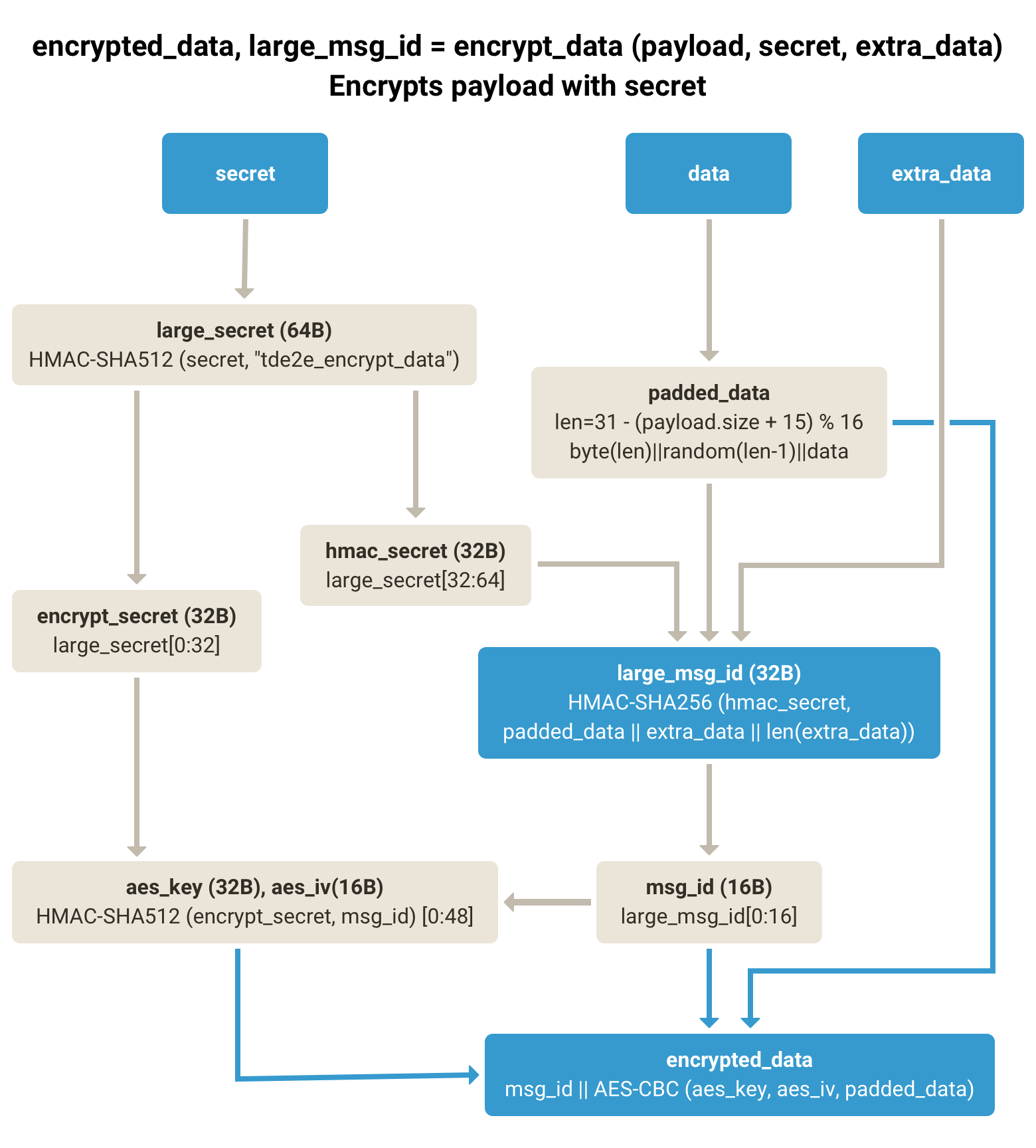
Encrypts
payloadusing asecret.extra_datawill be used as part of MAC.large_msg_idwill be used later to sign the packet.
padding_size = 16 + 15 - (payload.size + 15) % 16
padding = random_bytes(padding_size)
padding[0] = padding_size
padded_data = padding || payload
large_secret = KDF(secret, "tde2e_encrypt_data")
encrypt_secret = large_secret[0:32]
hmac_secret = large_secret[32:64]
large_msg_id = HMAC-SHA256(hmac_secret, padded_data || extra_data || len(extra_data))
msg_id = large_msg_id[0:16]
(aes_key, aes_iv) = HMAC-SHA512(encrypt_secret, msg_id)[0:48]
encrypted = aes_cbc(aes_key, aes_iv, padded_data)
Result: (msg_id || encrypted), large_msg_id
- encrypt_header(header, encrypted_msg, secret)
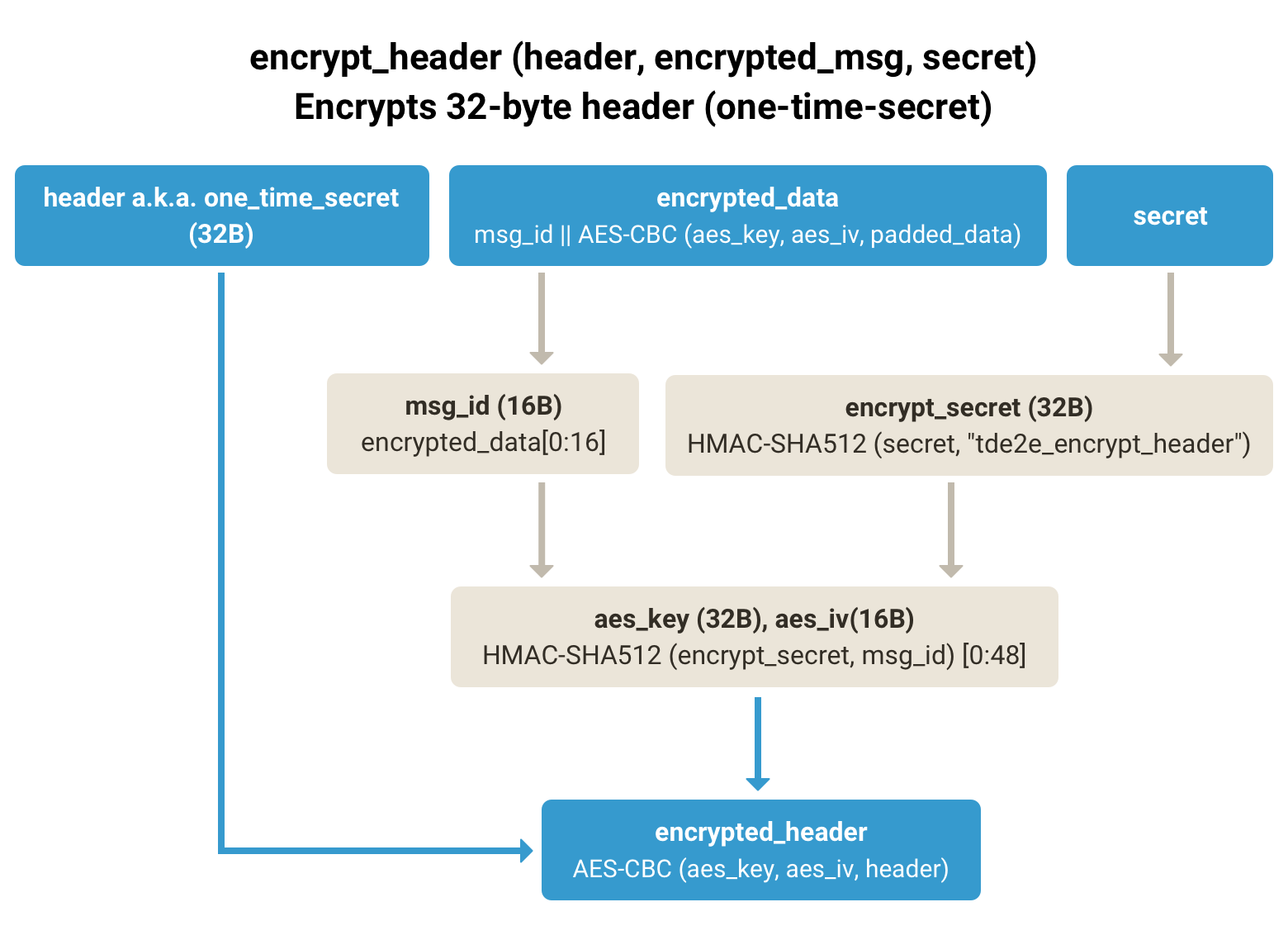
Encrypts a 32-byte
headerusing context fromencrypted_msgand asecret.
msg_id = encrypted_msg[0:16]
encrypt_secret = KDF(secret, "tde2e_encrypt_header")[0:32]
(aes_key, aes_iv) = HMAC-SHA512(encrypt_secret, msg_id)[0:48]
encrypted_header = aes_cbc(aes_key, aes_iv, header)
Security:
- Decryption routines must re-calculate and verify the
msg_idbefore processing the decrypted payload. - Replay protection is managed at the packet level using
seqno.
Packet Encryption
Audio, video and conference in-call message packets are encrypted using the following process:
- encrypt_packet(payload, extra_data, active_epochs, user_id, channel_id, seqno, private_key)
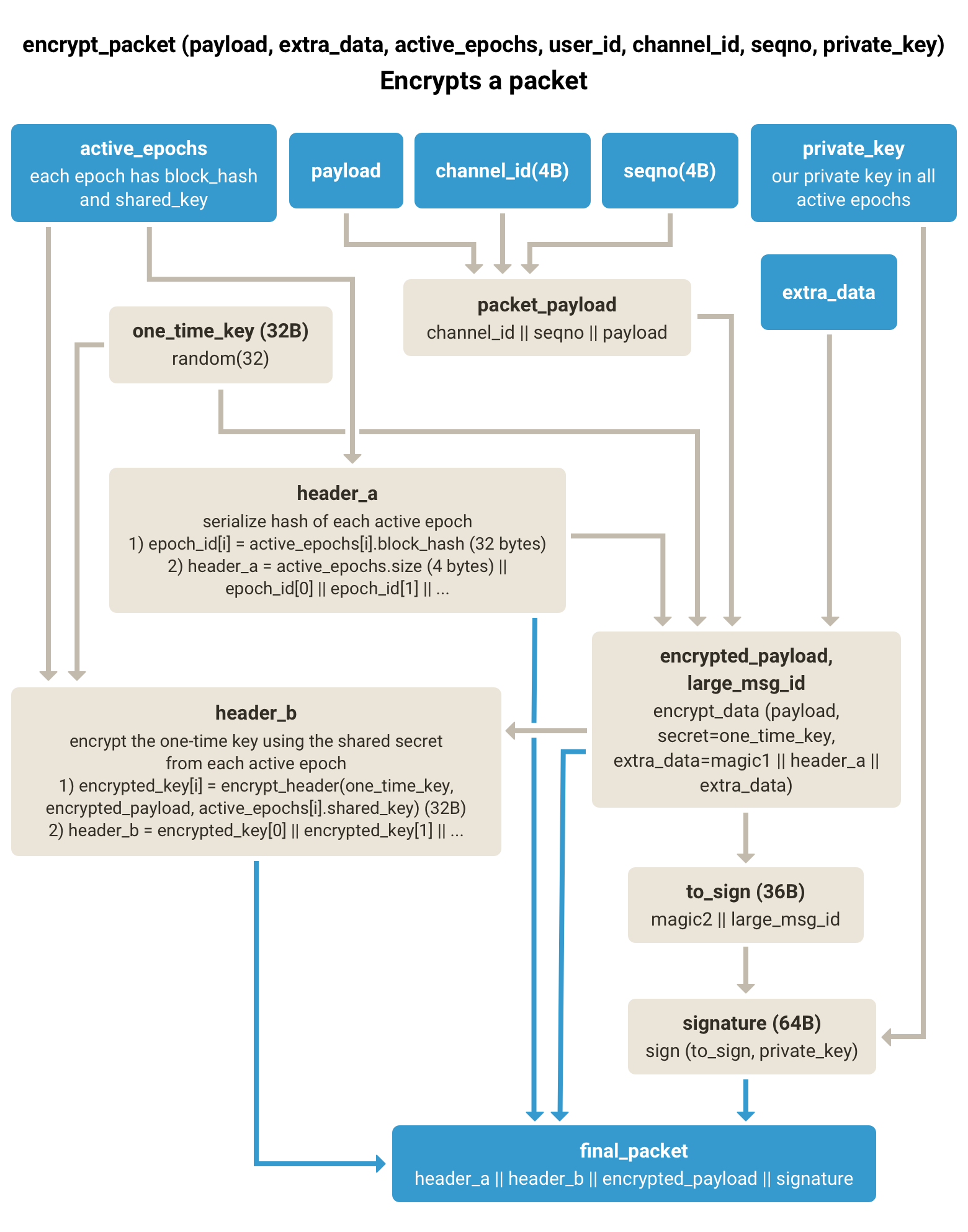
Encrypts
payloadfor transmission, associating it with active blockchain epochs. Epochs are essentially blocks whose shared keys are currently used for encryption.
-
Generate Header A (Epoch List):
epoch_id[i] = active_epochs[i].block_hash(32 bytes per epoch_id)header_a = active_epochs.size (4 bytes) || epoch_id[0] || epoch_id[1] || ...
-
Encrypt Payload with One-Time Key:
one_time_key = random(32)packet_payload = channel_id (4 bytes) || seqno (4 bytes) || payloadinner_extra_data = magic1 || header_a || extra_dataencrypted_payload, large_msg_id = encrypt_data(packet_payload, one_time_key, inner_extra_data)
-
Generate signature
signature = sign(magic2 || large_msg_id, private_key)
-
Generate Header B (Encrypted One-Time Keys):
- For each
iinactive_epochs:encrypted_key[i] = encrypt_header(one_time_key, encrypted_payload, active_epochs[i].shared_key)
header_b = encrypted_key[0] || encrypted_key[1] || ...
- For each
-
Final Packet:
extra_data || header_a || header_b || encrypted_payload || signature || extra_data_size.
The final unencrypted_prefix_size is a 4-byte little-endian integer stored at the end of the packet. On decryption, receivers first remove this trailer, split off the unencrypted prefix, parse header_a and header_b, and then try the advertised epochs until one decrypts the one-time key successfully.
magic1 is the CRC32 constructor magic (the part after #) for e2e.callPacket.
magic2 is the CRC32 constructor magic (the part after #) for e2e.callPacketLargeMsgId.
Security Considerations
- Replay Protection: The
seqnomust be unique and monotonically increasing for each(public key, channel_id)pair. In case of overflow, the client must leave the call. Receivers must track recently receivedseqnovalues and discard packets with old or duplicate numbers. - Signature Verification: During decryption, the receiver must use the
user_id(provided out-of-band) to look up the sender'spublic_keyin the relevant blockchain state (epoch specified inheader_a). The signature is stored as the 64 bytes immediately followingencrypted_payload, and this public key is used to verify it againstmagic2 || large_msg_idafter recalculatinglarge_msg_idwhile decrypting the payload. - Unique private keys: Clients must use unique private keys each time they add themselves to the blockchain. Otherwise, replay attacks could be possible.
Shared Key Encryption
When a ChangeSetSharedKey operation occurs in the blockchain, the new shared key material is distributed securely as follows:
-
Generate New Material:
raw_group_shared_key = random(32 bytes)(The actual shared key for data encryption).one_time_secret = random(32 bytes)(A temporary secret for encrypting the raw_group_shared_key).e_private_key, e_public_key = generate_private_key()(Ephemeral key pair used to derive the per-participant secret, one_time_secret)
-
Encrypt the Group Shared Key:
encrypted_group_shared_key = encrypt_data(raw_group_shared_key, one_time_secret)
-
Encrypt
one_time_secretfor Each Participant:- For each
participantin the current group state:shared_secret = compute_shared_secret(e_private_key, participant.public_key)encrypted_header = encrypt_header(one_time_secret, encrypted_group_shared_key, shared_secret)
- For each
-
Store in Blockchain: The
e_public_key,encrypted_group_shared_key, and the list ofencrypted_header(one per participant) are recorded in the blockchain state. -
Generate the real shared key used for packet encryption: (only for protocol version >= 1)
block_hashis the hash of the block where this shared key is set.group_shared_key=HMAC-SHA512(raw_group_shared_key, block_hash)[0:32]
Each accepted main-chain block creates a new encryption epoch identified by that block hash. Old epochs remain usable for a short grace period, so packets in flight can still be decrypted; tdlib currently keeps old epochs for about 10 seconds and caps the active epoch list at 15.
Security Considerations
- Decryption is not guaranteed for all participants (e.g., if a participant has an outdated app or corrupted state).
- However, all participants who can successfully decrypt the key material (by reversing the
encrypt_headerandencrypt_datasteps using their private key and the ephemeral public key) will arrive at the identicalgroup_shared_key. - Participants unable to decrypt the key must exit the call immediately, and specifically must not participate in the emoji generation process.
Key Verification and Emoji Generation
To ensure participants are communicating securely without a Man-in-the-Middle (MitM) attack, and to prevent manipulation of verification codes, a commit-reveal protocol is used to generate emojis based on the blockchain state and shared randomness.
Commit-Reveal Protocol Workflow
The protocol is run for every newly accepted main-chain block. The selected block is identified by (chain_height, chain_hash), respectively the height and the hash of the selected block.
-
Initial Setup (Per Participant):
- Generate a cryptographically secure random 32-byte nonce.
- Compute
nonce_hash = SHA256(nonce).
-
Commit Phase:
- Each participant broadcasts their
nonce_hash,chain_heightandchain_hashwith a signature. - Use the e2e.chain.groupBroadcastNonceCommit structure.
- The system (coordinated via the server) waits until commits have been received from all expected participants (based on the blockchain state at the specified height).
- Each participant broadcasts their
-
Reveal Phase:
- Once all commits are collected, each participant broadcasts their original
nonce, again with a signature. - Use the e2e.chain.groupBroadcastNonceReveal structure.
- The system verifies each revealed
nonceby checkingSHA256(revealed_nonce) == committed_nonce_hash. - The system waits until all valid nonces have been revealed.
- Once all commits are collected, each participant broadcasts their original
-
Final Hash Generation:
- Concatenate all successfully revealed raw 32-byte nonces sorted in lexicographic byte order. Let this be
concatenated_sorted_nonces. - Obtain the
blockchain_hash(the hash of the latest block for which verification is being performed). - Compute
emoji_hash = HMAC-SHA512(key=concatenated_sorted_nonces, message=blockchain_hash). - Take the first 32 bytes of
emoji_hash, ignoring the remaining 32 bytes. - Convert this
emoji_hash_slicedinto the four-emoji fingerprint described below.
- Concatenate all successfully revealed raw 32-byte nonces sorted in lexicographic byte order. Let this be
Emoji Fingerprint Generation
A 32-byte binary string (emoji_hash_sliced for group calls, SHA256(key || g_a) for one-on-one calls) is converted into an ordered fingerprint of four emojis as follows:
- Divide these bytes into 4 consecutive 8-byte chunks.
- Clear the highest bit of the first byte of each chunk.
- Interpret each chunk as a big-endian unsigned 64-bit integer.
- Reduce each integer modulo the length of the fixed, ordered fingerprint emoji table used by Telegram clients (which has 333 elements).
- Use the 4 resulting values as indexes into the emoji table, preserving their order.
In pseudocode:
fingerprint_hash = emoji_hash[0:32]

for i in 0..3:
    offset = i * 8
    value = big_endian_uint64(fingerprint_hash[offset:offset + 8])
    value &= 0x7fffffffffffffff
    fingerprint[i] = emoji_table[value % emoji_table.length]

// fingerprint now contains the 4 emojis
See here » for the exact contents of the emoji table (contains 333 emojis).
TL Schema for Broadcasts
// Phase 1: Commit
e2e.chain.groupBroadcastNonceCommit#d1512ae7 signature:int512 user_id:int64 chain_height:int32 chain_hash:int256 nonce_hash:int256 = e2e.chain.GroupBroadcast;

// Phase 2: Reveal
e2e.chain.groupBroadcastNonceReveal#83f4f9d8 signature:int512 user_id:int64 chain_height:int32 chain_hash:int256 nonce:int256 = e2e.chain.GroupBroadcast;
The public_key is extracted from the user's e2e.chain.groupParticipant object using the user_id.
The signature in both cases covers the TL-serialized object with the signature field itself zeroed out.
Security Considerations
- The final
emoji_hashis unpredictable to any single participant before the reveal phase, as it depends on random nonces from all others. - Participants should only process broadcast messages (commits/reveals) received from the server. Emojis should only be displayed once the process completes successfully for all participants (within reasonable network latency).
- The two-phase protocol prevents any participant (even one controlling block creation) from selectively revealing their nonce or trying multiple nonces to influence the final emoji outcome based on others' revealed values.
Full TL Schema
e2e.chain.groupBroadcastNonceCommit#d1512ae7 signature:int512 user_id:int64 chain_height:int32 chain_hash:int256 nonce_hash:int256 = e2e.chain.GroupBroadcast;
e2e.chain.groupBroadcastNonceReveal#83f4f9d8 signature:int512 user_id:int64 chain_height:int32 chain_hash:int256 nonce:int256 = e2e.chain.GroupBroadcast;

e2e.chain.groupParticipant#28852f20 user_id:long public_key:int256 flags:# add_users:flags.0?true remove_users:flags.1?true set_value:flags.2?true version:int = e2e.chain.GroupParticipant;

e2e.chain.groupState#1ddc7584 participants:Vector<e2e.chain.GroupParticipant> external_permissions:int = e2e.chain.GroupState;

e2e.chain.sharedKey#8a847e7f ek:int256 encrypted_shared_key:string dest_user_id:Vector<long> dest_header:Vector<bytes> = e2e.chain.SharedKey;

e2e.chain.changeNoop#deb4a41b nonce:int256 = e2e.chain.Change;
e2e.chain.changeSetValue#7c4f9bfa key:bytes value:bytes = e2e.chain.Change;
e2e.chain.changeSetGroupState#2cf17146 group_state:e2e.chain.GroupState = e2e.chain.Change;
e2e.chain.changeSetSharedKey#987a2158 shared_key:e2e.chain.SharedKey = e2e.chain.Change;

e2e.chain.stateProof#d6b679e6 flags:# kv_hash:int256 group_state:flags.0?e2e.chain.GroupState shared_key:flags.1?e2e.chain.SharedKey = e2e.chain.StateProof;

e2e.chain.block#639a3db6 signature:int512 flags:# prev_block_hash:int256 changes:Vector<e2e.chain.Change> height:int state_proof:e2e.chain.StateProof signature_public_key:flags.0?int256 = e2e.chain.Block;

e2e.callPacket#40a6bee9 = e2e.CallPacket;

e2e.callPacketLargeMsgId#1ce56c2d = e2e.CallPacketLargeMsgId;